
- Home
- Publication/ Seminar, /Symposium
- Tourism Culture Back Issues
- The essence of high value-added tourism [vol.267]
2025.11.20
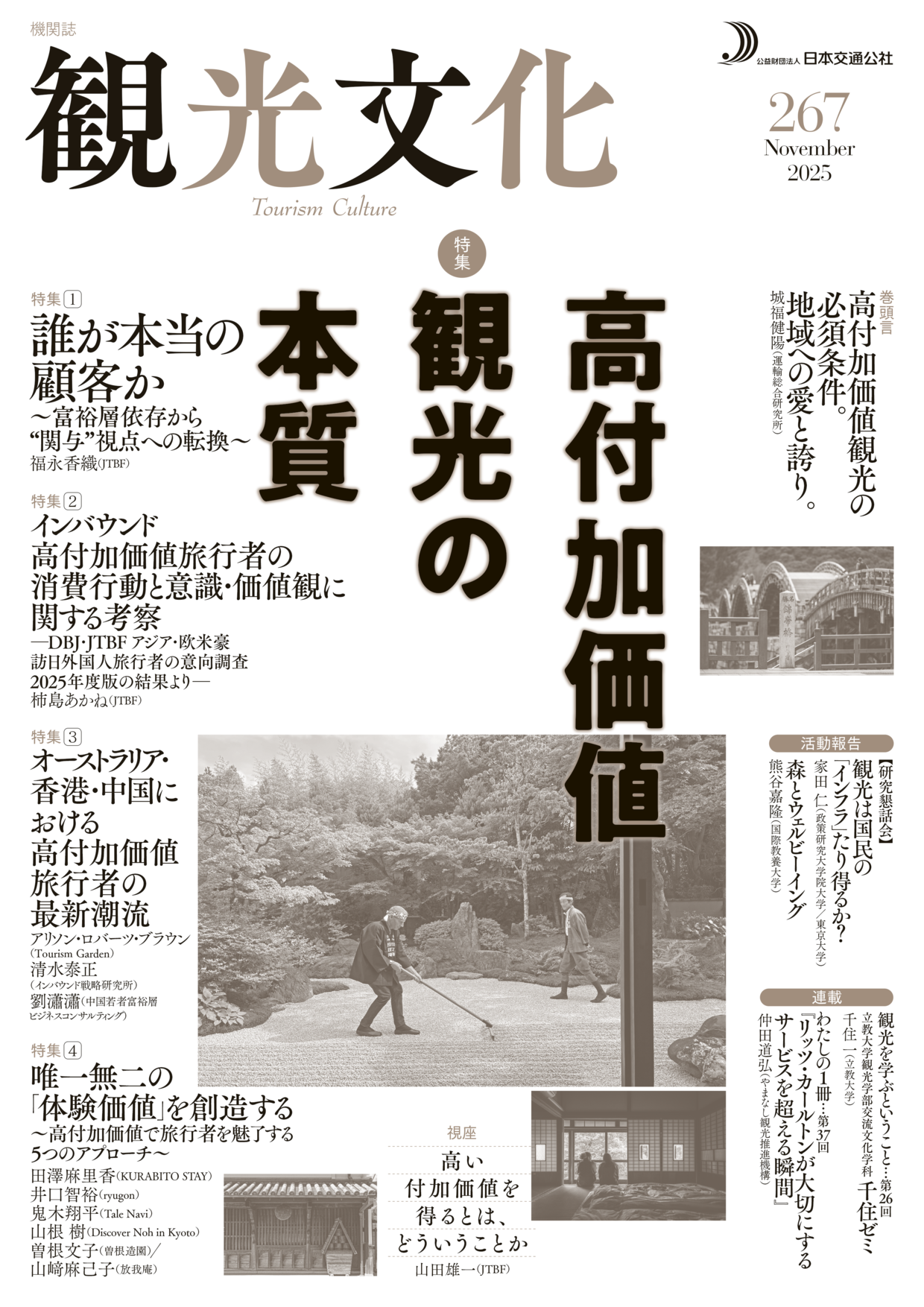
- The essence of high value-added tourism [vol.267]
-
The Japan Tourism Agency defines high-value-added travelers as “those who not only spend a large amount per trip, but who also tend to possess strong intellectual curiosity and a spirit of exploration, valuing opportunities to deepen their knowledge and gain inspiration through various travel experiences that allow them to engage with local traditions, culture, and nature.”
Attracting such high-value-added travelers can help stimulate local economies while easing the burden on communities by increasing per-visitor spending without increasing the total number of travelers. It also holds the potential to promote mutual understanding between regions and travelers.
This feature focuses on quantitatively and qualitatively identifying the high-value-added traveler segment, whose actual state has so far remained unclear. It also introduces specific examples of experiential content created for this target group and explores future challenges and prospects.
Published Nov 2025 Size, Number of Pages A4, 63pages Price ¥1,540 Tax Included